Abstract
Florida generates millions of tons of construction and demolition (C&D) debris annually, yet recycling performance varies widely across counties and is often limited by economic and infrastructure constraints. Despite documented economic and environmental benefits of C&D recycling, most Florida counties operate without a diversion ordinance. County officials seeking to improve C&D recycling rates face a fundamental problem: they lack the analytical tools to evaluate how alternative policy designs, diversion mandates, deposit-refund systems, differential tipping fees, facility certification standards, procurement mandates for recycled materials, or combinations thereof, would perform under their specific local conditions before committing public resources and political capital to implementation.
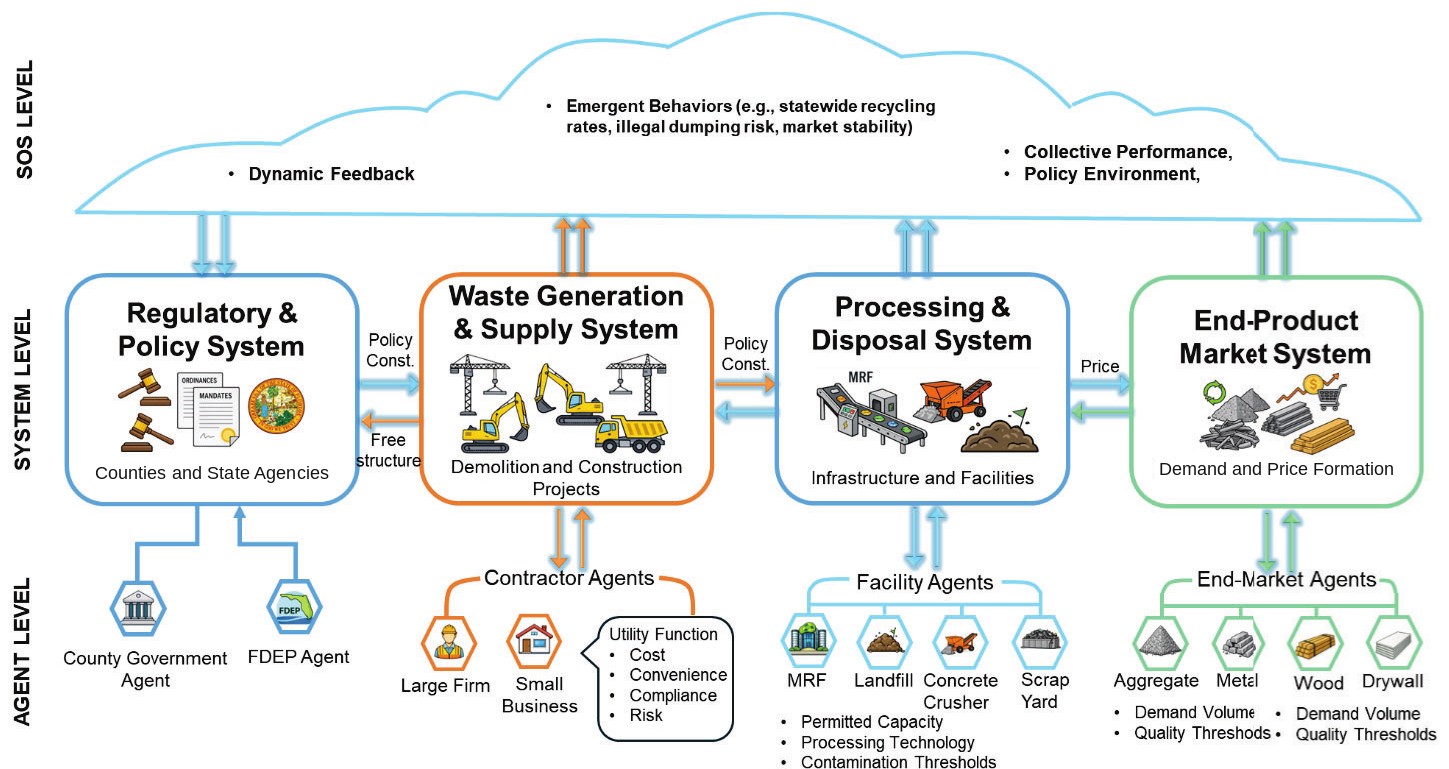
This project develops a decision-support simulation prototype designed to give county solid waste managers, planners, elected officials, and recycling industry stakeholders a practical means of testing C&D recycling policy options before adopting them. The prototype models the key actors in the C&D waste system (i.e., contractors of different firm sizes making material-by-material disposal decisions, recycling facilities with specific processing capacities and gate policies, landfills, end-product markets, and regulatory bodies) and captures how these actors interact and respond when policy conditions change. The model accounts for the factors that drive disposal decisions in practice such as cost, convenience, compliance pressure, risk tolerance, and the reality that a large demolition firm with established recycling relationships will respond to a new ordinance very differently than a small contractor accustomed to landfilling.
The research is carried out in four phases. The first documents the current regulatory environment, fee structures, facility characteristics, and contractor practices across Florida counties. The second translates these findings into a structured model of how stakeholders make decisions, how materials flow through the system, and where policy interventions take effect. The third builds and validates the simulation, calibrating it against observed diversion rates in a representative Florida county with different policy environments and facility infrastructure. The fourth applies the validated prototype to test various policy architectures. Each scenario is tested under county-specific conditions to determine not only whether a policy improves diversion, but by how much, at what cost, with what impact on different sizes of contracting firms, and with what unintended consequences including illegal dumping, processing bottlenecks at recycling facilities, material leakage to neighboring counties, and market saturation of recycled products.
This prototype is designed from the outset to demonstrate a practitioner-operated tool, developed and tested for a single Florida county as a proof of concept. County staff can input their own local parameters (e.g., tipping fees, facility locations, contractor populations, hauling distances, and current diversion rates) and receive outputs that directly inform policy decisions: projected diversion rates with confidence intervals, compliance costs broken down by contractor firm size, facility utilization and bottleneck risk, enforcement staffing requirements, net fiscal impact to the county, and environmental benefits including estimated greenhouse gas reductions.